

To read this article in Englis click here
Como sospecho que les ocurrió a millones, amanecí el domingo pasado un tanto tenso, nervioso, como si estuviera por enfrentar una de esas pruebas que pueden cambiarte la vida: un examen final o una entrevista para conseguir el empleo soñado. Lo curioso es que, a mi edad, ya no tengo —ni imagino tener— un desafío de tal magnitud. Si llegase a presentarse —nunca hay que perder la esperanza— creo que me alteraría bastante menos.
De cualquier manera, la causa de mi inquietud, como quizás la de tantos otros, era, en esencia, una circunstancia bastante banal: el partido de futbol de ese día en el que México se enfrentaría a Inglaterra por un lugar en los cuartos de final del Mundial. Había seguido de cerca el desempeño de la selección a lo largo del torneo, como lo he hecho desde que tenía ocho años, y lo que había mostrado el equipo, cuatro victorias al hilo, sin recibir gol y jugando cada vez mejor, me entusiasmaba como no sucedía desde hacía mucho tiempo.
La suerte, además, me había sonreído. Había obtenido dos boletos en el sorteo inicial de la FIFA para ese encuentro. Por el nivel que ambos equipos venían mostrando y por las pasiones que despierta el futbol en México e Inglaterra, el partido en el Azteca parecía ser el más atractivo de la Copa del Mundo hasta ese entonces.
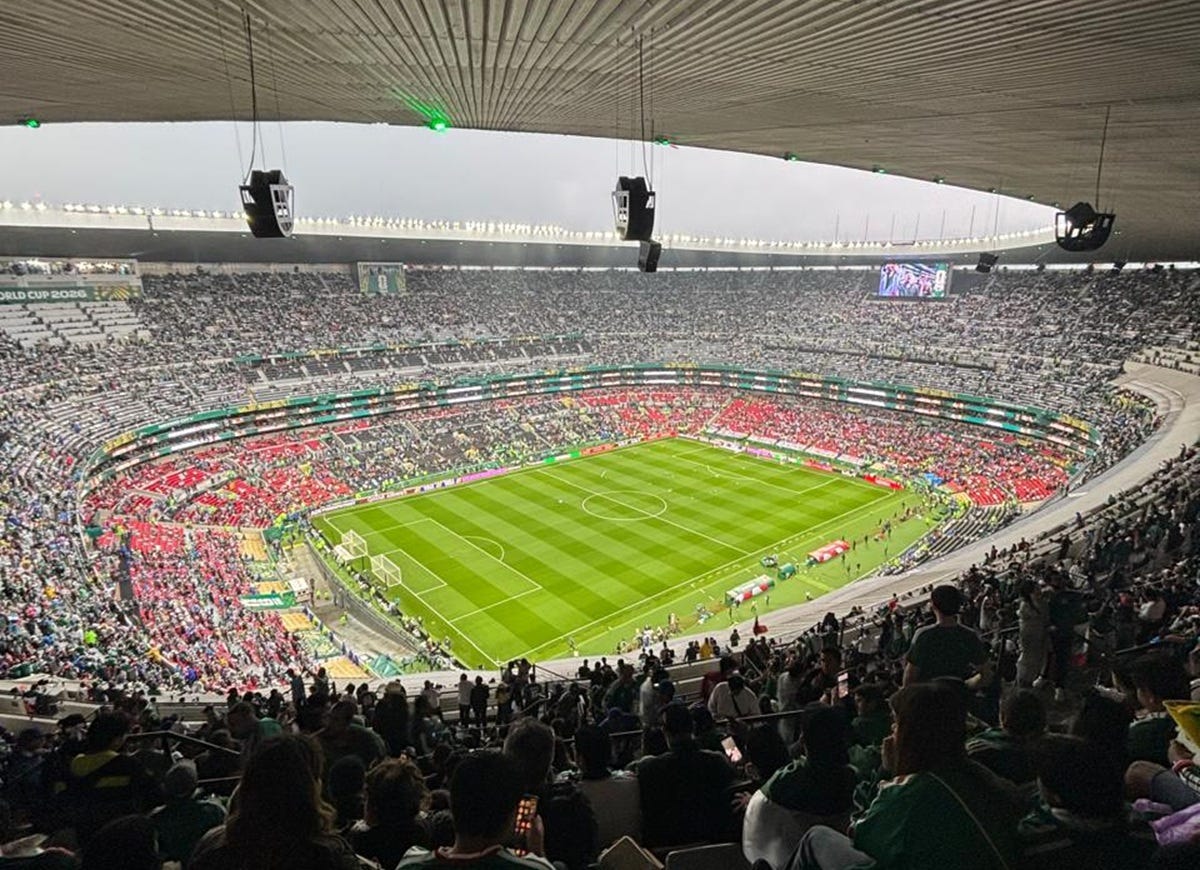
El Estadio Azteca, dos horas antes del partido entre México e Inglaterra por los octavos de final de la Copa Mundial de la FIFA 2026. Foto Eduardo García
La esperada salida al estadio con Gabriel, mi hijo, unas horas más tarde, probablemente terminó de elevar mi ansiedad a lo largo de la mañana. Estaría presente en lo que sobrinos y amigos calificaban como un juego “histórico”. (Nunca me ha entusiasmado aplicar ese adjetivo a eventos deportivos. Salvo contadas excepciones —como el encuentro que precedió a una breve guerra en Centroamérica generada por una disputa deportiva— los partidos de futbol, por más ruido y conmoción que generan, rara vez alteran la Historia con H mayúscula.)
Desde temprano advertí a mi familia que, por la tarde, llovería sobre el Azteca y que una tormenta eléctrica retrasaría el inicio del partido. Al menos en materia climática, acerté por completo: comenzó a llover cuando salimos de casa y el encuentro arrancó una hora más tarde de lo previsto.
El traslado al estadio duró cerca de una hora, un poco más de lo que había previsto, pero nada fuera de lo planeado. Bajo instrucciones de Gabriel, quien había tardado dos horas en llegar al Azteca para el partido anterior de la selección contra Ecuador, partimos rumbo a la parada casi cuatro horas antes del silbatazo inicial. Media hora después ya íbamos rumbo al estadio, con tiempo de sobra para llegar, caminar bajo la lluvia, secarnos e instalarnos en nuestros asientos, ubicados apenas dos filas por debajo de la parte más alta del inmueble y, por fortuna, bajo techo.
Los relámpagos que iluminaron la región sur de la ciudad durante el trayecto confirmaban mi pronóstico en cuanto a la hora de inicio del partido.
El ambiente, desde el camión hasta el estadio, fue vibrante. Cantos, bromas, risas, gritos desesperados de apoyo a la selección y una multitud, que, pese a la lluvia, confiaba, ansiaba y esperaba un triunfo de México.
No podían faltar, por supuesto, los inconvenientes. Si bien la ciudad dio un paso adelante con el servicio especial de transporte para trasladar a los aficionados al Azteca, dio otro atrás con la organización de los accesos. Bloqueó las entradas a las escaleras que comunicaban los andenes donde descendimos con el puente peatonal que te llevaba a los sitios de seguridad y torniquetes del estadio. ¿La razón? Una supuesta aglomeración delante de nosotros que yo, al menos, nunca vi. La decisión obligó a miles de personas a caminar medio kilómetro más bajo la lluvia para ingresar por un acceso habitualmente reservado a los vehículos.
Cuántas decisiones inexplicables como esa toman todavía nuestras autoridades. Medidas que parecen carecer de lógica y cuya justificación desconocen incluso los servidores encargados de aplicarlas. En México, el progreso rara vez es lineal: los avances conviven, una y otra vez, con tropiezos.
Volví a comprobar esta tesis apenas intenté caminar por la fila ocho de la sección 602 del Azteca para llegar a nuestros asientos. Gabriel y yo simplemente no pudimos hacerlo. Nuestro pasillo, el de abajo y los dos de arriba estaban completamente inundados. Algo desconcertante: las cuatro filas estaban protegidas de la incesante lluvia que caía sobre el Azteca. Bajamos hasta la fila cinco o seis para evitar empaparnos los zapatos. Los pasillos eran pequeñas albercas de cuatro o cinco centímetros de profundidad por el agua que retenía el zoclo de cada hilera.
Al llegar entendí el problema. Una canaleta instalada en el techo para conducir el agua de lluvia escurría como una cascada sobre la última fila. La remodelación millonaria del Azteca —emprendida por Ollamani para convertirlo en un estadio de “primer mundo”— evidenciaba una ejecución deficiente. Aquella fuga revelaba una vieja costumbre mexicana: inaugurar obras antes de cuidar los detalles que terminan confirmando —o desmintiendo— la calidad de la transformación.
El Azteca, como las decisiones de las autoridades de la ciudad, empezaba también a parecerme una metáfora incómoda del país.
Los momentos previos al partido —los decibeles ensordecedores de la afición, el himno entonado a todo pulmón y el respeto con el que la multitud recibió el God Save the King— me hicieron olvidar esos inconvenientes menores. Hasta que Inglaterra abrió el marcador al minuto 35.
Dos videos documentan algunos de las inconveniencias registradas durante el partido entre México e Inglaterra en el Estadio Azteca. En el primero (izquierda), aficionados caminan medio kilómetro adicional debido al cierre de las escaleras que conectaban con el puente peatonal. En el segundo, una fuga en la canaleta superior del techo provoca una cascada de agua sobre los espectadores tras la reciente remodelación del estadio. Videos Eduardo García.
Con ese gol volví a sentir que el gran momento que vivía la selección mexicana comenzaba a desmoronarse. Hasta entonces México había jugado mejor. Tanto, que Harry Kane, el muy popular centro delantero inglés, no había tocado el balón durante los primeros treinta minutos del juego, como Gabriel me hizo notar unos instantes antes.
Javier Aguirre, el entrenador de México, había sido valiente. Planteó un partido para atacar. No especuló. Confió en que el empuje de la afición y el talento de los futbolistas mexicanos bastarían para vencer a Inglaterra. El remate de palomita de Raúl Jiménez al minuto 15, que Jordan Pickford desvió con una estirada espectacular junto a la base del poste izquierdo, reforzó esa sensación.
No obstante, veinte minutos después, en pleno dominio mexicano, bastaron dos distracciones en menos de tres minutos para transformar la euforia en silencio. Primero, un contragolpe inglés terminó en el 1-0. Poco después, un robo de balón delante de media cancha desembocó en el segundo tanto. Ambos fueron obra de Jude Bellingham, cuya velocidad y efectividad desataron lo que parecía una hecatombe en el Azteca.
Parecía imposible que el Tri pudiera reaccionar. Pero lo hizo. Este equipo estaba hecho de otra sustancia. A cuatro minutos del descanso, Julián Quiñónes, el colombiano más mexicano del mundo, aprovechó un mal despeje de la defensa inglesa tras un tiro libre para hacer un disparo imposible de detener para Pickford. Gol de México.
La confianza regresó de inmediato al estadio. Dos llegadas consecutivas al área inglesa, ambas muy cerca de lograr el empate, devolvieron los decibeles perdidos. El Azteca volvió así a ser un manicomio. El ambiente terminó de incendiarse cuando, tras el descanso, el defensa inglés Jarell Quansah salió expulsado por una dura entrada sobre Jesús Gallardo.
En ese momento creo que nadie dudaba de que México terminaría empatando el juego. Seis minutos más tarde, sin embargo, llegó otro error decisivo. Edson Álvarez, quien había ingresado por lesión del defensa central César Montes, no logró despejar correctamente un saque de meta y obligó a José Raúl ‘Tala’ Rangel a cometer un penalti. El portero terminó aplicando aquella vieja —y para mí equivocada— máxima de: pasa el balón o pasa el jugador, pero no los dos.
Con el cobro de Kane, México volvió a quedar dos goles abajo. Otro penalti cometido ahora por el propio delantero inglés contra Brian Gutiérrez al minuto 65 permitió que Jiménez descontara con un cobro impecable.
Quedaban 25 minutos, más el tiempo agregado. Inglaterra jugaba con 10 hombres y el estadio empujaba con todo a la selección. Pero el futbol que México había mostrado hasta entonces —sobre todo su creatividad— desapareció. Se secó. El equipo fue incapaz de abrir la defensa inglesa. Todo se volvió predecible. Los minutos transcurrieron sin que Inglaterra sintiera verdadero peligro hasta que llegó el silbatazo final y, con él, el fin del sueño mexicano.
De inmediato muchos hablaron de fracaso, sobre todo porque, en las dos Copas del Mundo anteriores disputadas en México, la selección había superado los octavos de final. A mí, sin embargo, pese a esa métrica en apariencia irrefutable, me cuesta llegar a la misma conclusión. México jugó el mejor futbol que le he visto en décadas y, aun así, quedó eliminado.
Era una paradoja similar a la que había visto esa tarde. El Azteca, cuya cancha remodelada resistió un aguacero sin formar un solo charco, no pudo evitar una cascada sobre algunos espectadores. La ciudad, cuya capacidad para transportar a miles de aficionados con una eficiencia inédita que sorprendió a todos, obligó inexplicablemente a miles de aficionados a caminar medio kilómetro de más por una decisión absurda. La selección avanzó, pero no lo suficiente para alcanzar la meta.
Pese a esas desavenencias, no tengo duda de que el país tuvo muchos éxitos en este Mundial. El mayor fue, quizá, haber devuelto la ilusión, sobre todo a los jóvenes. Lo comprobé no solo en el Azteca, sino también en las calles y en los Metrobuses de la ciudad, donde vi a miles celebrar las victorias del Tri con una alegría contagiosa que hacía mucho no veía.
La lección que me deja este Mundial es que México rara vez avanza en línea recta. Da más bien dos pasos hacia adelante y uno hacia atrás, o viceversa. La Copa del Mundo volvió a recordármelo.
Pero este Mundial también generó algo que no había visto antes. La pregunta “¿y si sí?”, convertida casi en el lema del torneo, abrió para mí una grieta en el fatalismo mexicano. Si el país fue capaz de imaginar, por improbable que fuera, la posibilidad de ganar esta Copa del Mundo, ¿por qué no imaginar también una mayor movilidad social, mejores gobiernos, empresas más responsables o, simplemente, mejores condiciones de vida para la mayoría?
Desde esa perspectiva, quizás el mayor legado de este Mundial no fue el avance futbolístico, sino haber devuelto al país una pregunta que parecía haber olvidado formularse: ¿y si sí? ¿Y si sí podemos jugar mejor? ¿Y si sí podemos gobernarnos juntos? ¿Y si sí podemos construir un país donde el progreso deje de parecer una sucesión interminable de avances y retrocesos?
No lo sé. Pero tras este Mundial, por primera vez en mucho tiempo, esa pregunta ha dejado de parecerme ingenua.
What If It Did?
The match ended. The question remained. Perhaps the greatest legacy of this World Cup wasn't footballing, but restoring the belief that a better country is possible.
by Eduardo García
Like, I suspect, millions of others, I woke up last Sunday feeling a little tense, nervous, as if I were about to face one of those moments that can change your life: a final exam or a job interview for your dream position. The curious thing is that, at my age, I no longer have —nor do I expect to have— a challenge of that magnitude. If one ever did come along —and one should never give up hope— I think it would unsettle me far less.
The source of my anxiety, like that of so many others, was, in the end, something rather trivial: Mexico’s World Cup match against England for a place in the quarterfinals. I had followed the national team’s progress throughout the tournament, just as I have since I was eight years old, and what I had seen —four straight victories, no goals conceded and increasingly confident play— had excited me more than I had been in years.
Luck, moreover, had smiled on me. I had secured two tickets in FIFA’s initial lottery for the match. Given the form both teams had shown and the passions football inspires in Mexico and England alike, the game at the Azteca promised to be the marquee match of the tournament up to that point.
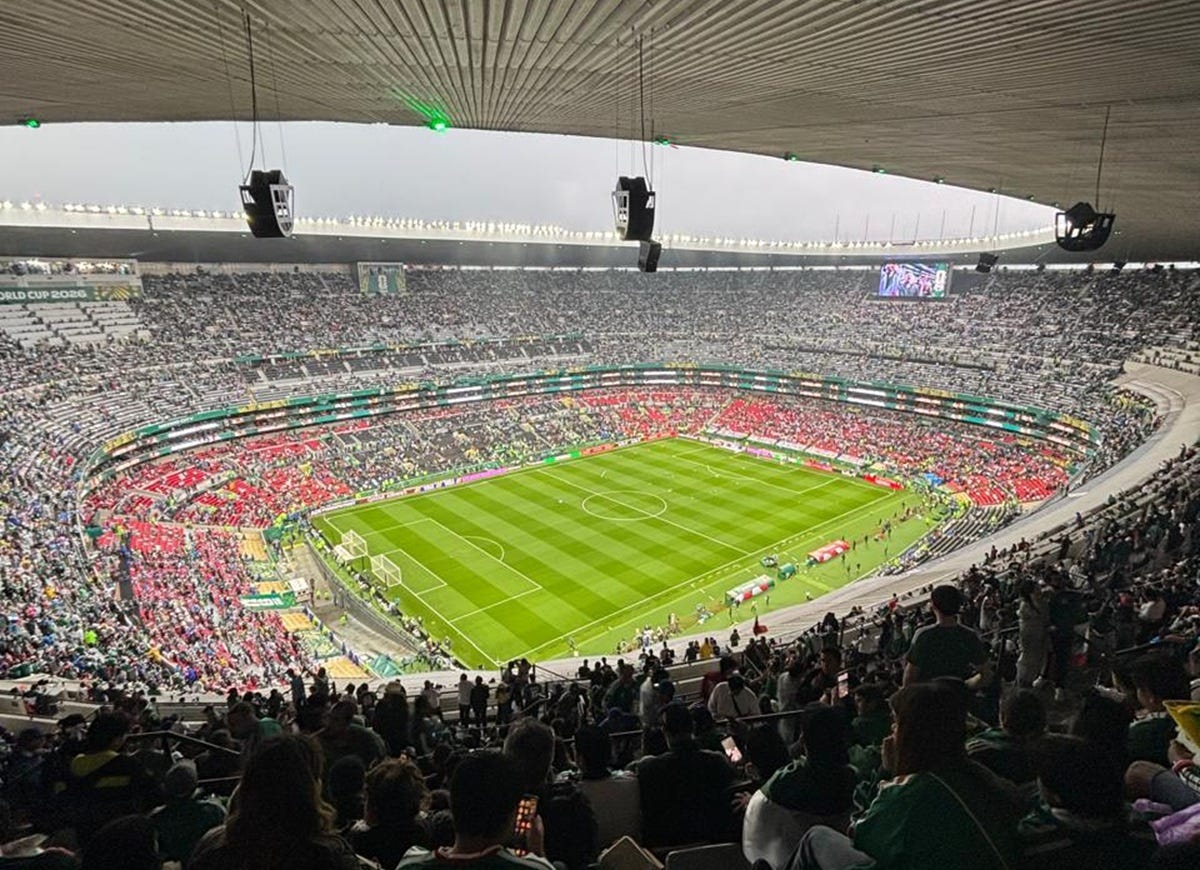
Azteca Stadium two hours before Mexico's Round of 16 match against England at the 2026 FIFA World Cup. Photo Eduardo García
Heading to the stadium with my son Gabriel a few hours later only heightened my anticipation. I was about to witness what my nephews and friends were calling a “historic” match. (I’ve never liked using that adjective for sporting events. With rare exceptions —such as the match that preceded the brief war between El Salvador and Honduras— football games, no matter how much emotion or commotion they generate, rarely alter History with a capital H.)
Early that morning, I warned my family that it would rain over the Azteca that afternoon and that a thunderstorm would delay kickoff. At least when it came to the weather, I was exactly right: it began raining as we left home, and the match started an hour later than scheduled.
The trip to the stadium took about an hour, a little longer than I had expected but still well within our plans. Following Gabriel’s advice —he had needed two hours to reach the Azteca for Mexico’s previous match against Ecuador— we left for the bus stop nearly four hours before kickoff. Half an hour later we were on our way, with plenty of time to arrive, walk through the rain, dry off and settle into our seats, located just two rows below the highest section of the stadium and, fortunately, under cover.
The lightning flashing across the southern part of the city during the trip confirmed my forecast about the delayed start.
The atmosphere, from the bus to the stadium itself, was electric. Songs, jokes, laughter, chants of support for the national team and a crowd that, despite the rain, believed, hoped and expected Mexico to win.
Of course, there were setbacks as well. While the city took a step forward by introducing a special transit service to carry fans to the Azteca, it took another backward in the way it managed access to the stadium. Officials blocked the stairways connecting the transit platforms to the pedestrian bridge leading to the security checkpoints and turnstiles. Why? Supposedly because of congestion ahead of us —though I never saw any. The decision forced thousands of fans to walk an extra half-kilometer through the rain to enter via an access road normally reserved for vehicles.
How many baffling decisions like that do our authorities still make? Measures that seem to defy common sense, whose rationale even the officials enforcing them cannot explain. In Mexico, progress is rarely linear. Advances coexist, time and again, with setbacks.
I was reminded of that as soon as I tried to walk down Row 8 of Section 602 to reach our seats. Gabriel and I simply couldn’t. Our row, the one below it and the two above were completely flooded. Strangely enough, all four rows were fully protected from the relentless rain falling over the Azteca. We climbed down to Row 5 or 6 to avoid soaking our shoes. The aisles had turned into shallow pools, four or five centimeters deep, because the raised edge along each row trapped the water.
When we reached our seats, I understood what had happened. A gutter installed beneath the roof to channel rainwater had sprung a leak, sending a waterfall cascading onto the last row. The multimillion-dollar renovation of the Azteca —undertaken by Ollamani to transform it into a “first-world” stadium— had exposed sloppy workmanship. That leak reflected an old Mexican habit: inaugurating projects before paying attention to the details that ultimately confirm —or undermine— the quality of the work.
The Azteca was beginning to strike me as an uncomfortable metaphor for the country itself.
The moments before kickoff —the deafening roar of the crowd, the national anthem sung at the top of thousands of lungs and the respectful silence during God Save the King— made me forget those minor inconveniences.
At least until England opened the scoring in the 35th minute.
Two videos document some of the problems that occurred during the Mexico–England match at Azteca Stadium. In the first (left), fans are forced to walk an additional half-kilometer after authorities closed the stairway leading to the pedestrian bridge. In the second, a leak in a roof gutter sends a cascade of water onto spectators despite the stadium's recent renovation. Videos Eduardo García
With that goal, I felt once again that the remarkable run Mexico had put together was beginning to unravel.
Up to that point, Mexico had been the better team. So much so that Harry Kane, England’s star striker, had barely touched the ball during the opening 30 minutes, as Gabriel pointed out to me just moments earlier.
Mexico coach Javier Aguirre had been bold. He set his team up to attack. He didn’t play cautiously. He trusted that the energy of the crowd and the talent of his players would be enough to beat England. Raúl Jiménez’s diving header in the 15th minute —brilliantly tipped around the post by Jordan Pickford— only reinforced that belief.
Then, 20 minutes later, with Mexico still in control, two lapses in concentration less than three minutes apart turned euphoria into silence. First, England scored on a counterattack. Moments later, a turnover near midfield led to a second goal. Both were scored by Jude Bellingham, whose speed and clinical finishing plunged the Azteca into what felt like collective despair.
A comeback suddenly seemed impossible.
But this team was made of something different.
Four minutes before halftime, Julián Quiñónes —the most Mexican Colombian in the world— pounced on a poor clearance after a free kick and rifled an unstoppable shot past Pickford.
Mexico had life again.
Belief instantly returned to the stadium. Two attacks in quick succession, both narrowly missing the equalizer, restored the noise that had briefly vanished. Once again, the Azteca became a madhouse.
The atmosphere reached another level shortly after halftime when England defender Jarell Quansah was sent off for a reckless challenge on Jesús Gallardo.
At that moment, I don’t think anyone doubted Mexico would find the equalizer.
Six minutes later, however, came another decisive mistake.
Edson Álvarez, who had come on after center back César Montes was injured, failed to clear a goal kick properly, forcing goalkeeper José Raúl “Tala” Rangel to bring down an English attacker inside the box.
Rangel ended up following that old —and, to me, misguided— maxim: either the ball gets past or the player does, but not both.
Kane converted the penalty, restoring England’s two-goal lead.
Another penalty, this time awarded after Kane fouled Brian Gutiérrez in the 65th minute, allowed Jiménez to pull one back with a flawless finish.
There were still 25 minutes to play, plus stoppage time.
England was down to 10 men, and the entire stadium was urging Mexico forward.
But the football Mexico had played so brilliantly until then —its creativity above all— simply vanished.
It dried up.
The team could no longer break through England’s defense. Everything became predictable.
The minutes slipped away without England ever feeling genuinely threatened until the final whistle blew, bringing Mexico’s dream to an end.
Many immediately called the tournament a failure, especially because Mexico had reached at least the quarterfinals in the two previous World Cups hosted on home soil.
I find it hard to reach the same conclusion.
Despite the elimination, Mexico played the best football I have seen from the national team in decades.
It was a paradox much like the one I had witnessed that afternoon.
The renovated pitch at the Azteca withstood a torrential downpour without forming a single puddle, yet it couldn’t prevent a waterfall from pouring onto some of the spectators. The city transported thousands of fans with unprecedented efficiency, only to force them to walk an extra half-kilometer because of an inexplicable decision. The national team, too, had made remarkable progress —but not enough to reach its goal.
Despite those contradictions, I have no doubt that Mexico achieved a great deal during this World Cup.
Its greatest success, perhaps, was restoring hope, especially among younger generations.
I saw it not only inside the Azteca but also on the city’s streets and aboard its Metrobús buses, where thousands celebrated El Tri’s victories with an infectious joy I hadn’t witnessed in a very long time.
The lesson this World Cup leaves me is that Mexico rarely moves in a straight line. It advances two steps, then slips back one —or sometimes the other way around.
This tournament reminded me of that once again.
But it also left me with something I had never seen before.
The question “What if it did?” —which became something of an unofficial motto throughout the tournament— opened what felt to me like a small crack in Mexico’s long-standing fatalism.
If the country could imagine —even however improbably— the possibility of winning the World Cup, why couldn’t it also imagine greater social mobility, better governments, more responsible businesses or, simply, better lives?
Seen from that perspective, perhaps the greatest legacy of this World Cup was not Mexico’s progress on the field, but the return of a question the country seemed to have forgotten how to ask:
What if it did?
What if we really can play better?
What if we really can govern ourselves better?
What if we really can build a country where progress no longer feels like an endless cycle of advances followed by setbacks?
I don’t know.
But after this World Cup, for the first time in a long while, that question no longer strikes me as naïve.
Otra muy buena reseña!!! Gracias y no dejes de escribir!!! Parece que estuve ahí!! je je
Que recuerdos mi flaco y aun mejor poder vivir la nueva aventura con Gabriel como la vivimos en el pasado. Yo con mis nietos lo pude disfrutar. Aun mas porque estuvimos en Mexico ,todos juntos para poder gozar. Y si, estoy contigo no pierdo la esperanza de que SI SE PUEDA.